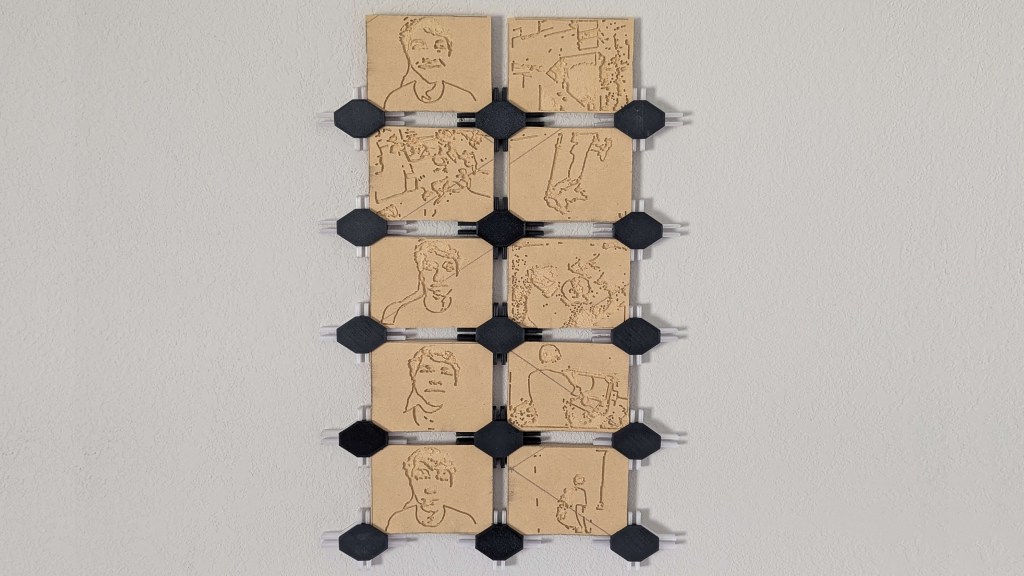
How do you take a 2 dimensional digital film and turn it into a 3 dimensional physical object? Henry and I wanted to answer this through an intersectionality project, combining our respective resident experts (Film and CNC) to create a final outcome that would bridge the gap between these planes. We create a series of CNC etched frames that can be arranged to create a new unique story each time. You can and should engage with Henry’s perspective on the CNC process through his article.
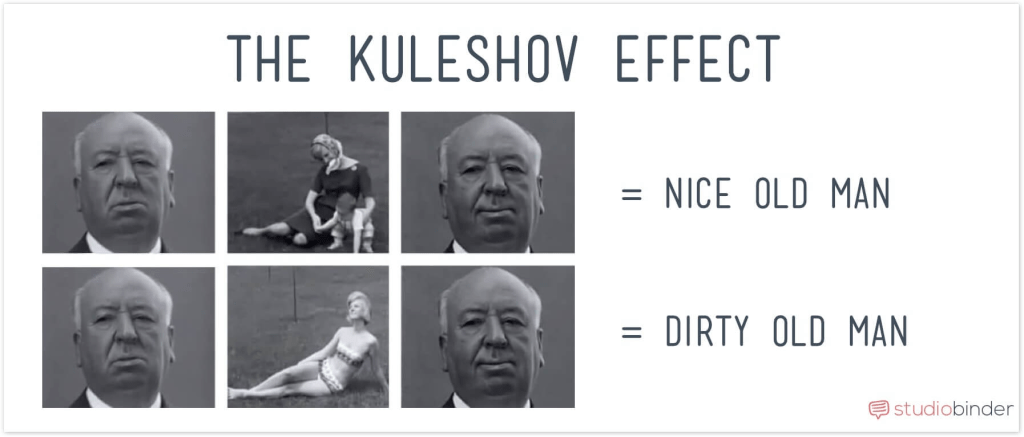
Our first idea was to take a film I created and extract selected frames from it. Then Henry would take those frames, convert them into 3d maps, and route them out on the CNC. Later we settled on the idea of adding more audience/user engagement to this piece by allowing people to arrange each frame to create a new story. This meant we couldn’t use any of my previous films or just make any random one, so I revisited the Kuleshov Effect.
The Kuleshov Effect is a editing style created by Russian filmmaker Lev Kuleshov in the 1910’s. It involves Juxtaposing two separate shots together to trick the mind and make it assume what a character on screen is thinking or feeling. For example in a film you have a character with a blank expression, then it cuts to a plate of food. You connect the two scenes together and assume that character is hungry.
With the Kuleshov Effect in mind, I drew out a storyboard with the idea to show what a day in the life of a AMP student looks like. I ended up with 20 frames; the first and last locked in place (unable to adjust), 9 face/reaction shots, and 9 action shots. These shots included our character working on various school projects, taking part in extra activities, and reactions based off of emotions like anger. After settling on those frames it was time to actually capture them digitally. With Henry as the character I took pictures, trying to replicate my sketch’s as much as possible. I took pictures instead of recording these like I normally would since that would add unnecessary steps with no marginal difference to the final outcome.
Unfortunately when it came to taking these images and turning them into files that the CNC would route was much more challenging then expected, again I would recommend checking out Henry’s article to get insight on that. This resulted with us having to cut the number of frames to half, resulting in 10 frames with 2 being locked (the second and last). The final outcome has 4 reaction and 4 action frames, each can be moved around to create a grand total of 144 unique stories. While it’s not what we originally envisioned, it still shows how one (or two) can take a digital piece of media and turn it into a physical 3 dimensional object!
 The Learning Repository