Every good product/outcome needs a good plan! Or that’s what most people say, and I would agree. Especially when it comes to making a good, cohesive film. While it’s not the glorified part of Filmmaking (camera work and editing) that everyone talks about, pre-production, or the planning and preparation phase, is essential to make a good film or even a film at all.
When I first started making films, I would get an idea of what I wanted to make and just wing it, often resulting in bad footage and a bland final outcome. Taking my time and implementing pre-production into my process has not only helped me organize my shots, scenes, and what I want them to look like but also refine my ideas for the overall film. As Joshua Woodlock (winner of the 2024 Cinequest Audience Award) puts it “At this point, I’ve already rewatched the film over and over in my head 100 times. I know what I like and don’t like about it. I see what limitations I might be facing.”

Pre-production encompasses many things that need to take place before a film’s shooting. It includes the script and plans for the film itself, sets, outfits, casting, and funding. All of which depends on the scale of the production and what you’re making. A professional director/filmographer will spend months writing, drawing, and coordinating the necessary resources to create the film. On the other hand, for high school students who just want to make films, it can take as little as a week, and not all of the steps are necessary. I like to think of pre-production in two sections, one being Story. This includes everything related to how the film will look and what direction it will take. The other is Logistics, which includes all of the technical aspects as well as casting and shooting locations.
You would start with the basis for your film, the script. Turning the initial ideas and concepts of the film into something more tangible, which can then be approved by the studio. Or if you’re an indie filmmaker (independent filmmaker), what you use to base the storyboard on. Once the script is approved, a breakdown will be made that includes all the times of day, locations, cast, props, special & sound effects, and anything else that will need to be logistically solved. This then leads to the next step, which is creating the budget. For students and some indie filmmakers, this isn’t a concern, as the films being created are, in most cases, to learn and improve upon, but for professionals in the field, it is a huge factor that determines how the final outcome will look.
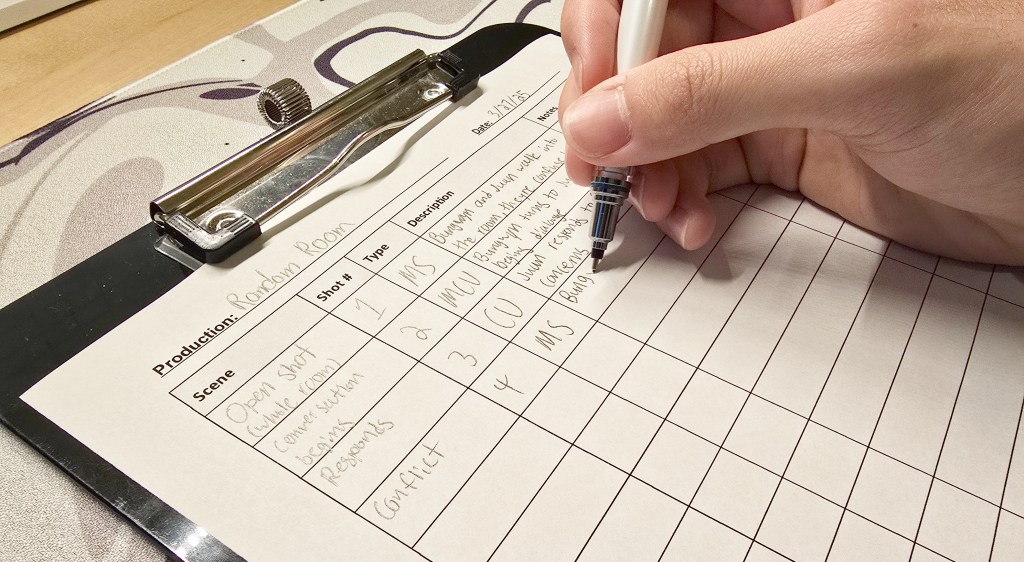
The next step will be figuring out the cast and schedule. If the film requires actors, stunt doubles, or background characters, the people who will play them will need to be cast. Then the production schedule will need to be made. What days do the shoots take place, what time, where, and who is needed? Those are all things that need to be logistically solved to ensure no unwanted surprises arise during production, for both professional and indie filmmakers. From there, the storyboard and shot list are made. The storyboard is a series of drawings that show what each scene looks like, and the shot list is the actual list of shots being filmed. The shot list also entails the location, camera positioning, and what scenes are included within each shot.
As I’m a high school student who makes films independently to learn and grow, I don’t do every step that makes up pre-production. However, ever since I began implementing the pre-production process into my workflow, I have noticed a substantial difference in the final outcome. The production and post-production processes have become much easier to navigate through, as I had everything laid out beforehand. The only thing left is to just do it.
 The Learning Repository